Every year, the GCC generates more than 150 million tonnes of waste. Construction debris, packaging, food, electronics, and industrial material- most of it heading straight to a landfill. For decades, that was simply how business worked. You take a resource, make something from it, sell it, and discard what remains. The economy moved in a straight line from extraction to disposal, and nobody questioned whether there was a better way.
There is a better way. And across the Arab world, businesses, governments, and investors are beginning to build it. The shift from a linear economy to a circular one is not just an environmental idea. It is an economic strategy, and the numbers behind it are making it impossible to ignore.
This blog discusses what circular economy business means, how it is taking shape across the Arab region, and why zero waste business thinking is becoming one of the most powerful competitive advantages a company can develop.
What Circular Economy Business Actually Means
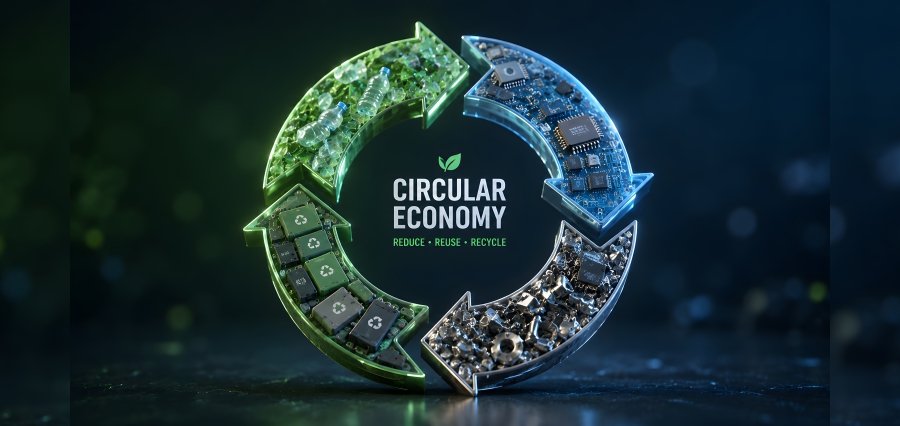
A circular economy business does not follow the traditional take, make, and discard model. Instead, it designs waste out of the process entirely. Materials are used for as long as feasible. Products are designed to be repaired, reused, or recycled rather than thrown away. When something reaches the end of its life, it becomes the input for something new.
This is not idealism. It is engineering applied to economics. A circular economy business reduces its dependence on raw materials, cuts disposal costs, and creates new revenue streams from what previously had no value. The resource that was once a cost becomes an asset.
Why the Arab Region Is Moving in This Direction
The Arab world has compelling reasons to embrace circular economy business beyond environmental motivation alone.
The GCC imports a significant portion of its raw materials. Building supply chain resilience by recovering and reusing materials domestically reduces that vulnerability. At the same time, national visions across the region have made sustainability central to economic planning.
Saudi Arabia’s Ministry of Environment, Water and Agriculture announced a waste management plan aiming to recycle up to 95 percent of waste and add SR120 billion to the Kingdom’s GDP. That figure makes the economic case clearly. This is not charity. It is commerce.
Saudi Arabia has set a target of diverting 82% of waste from landfills by 2035, while the UAE has set a 75% diversion goal by 2025. Both targets require significant private sector participation, which means real business opportunity for companies willing to move early.
Real Examples Already Taking Shape
The transition is not theoretical. Circular economy business models are already operating across the region.
The Saudi Investment Recycling Company, or SIRC, is the implementation body for all circular economy investments and sustainability projects within Saudi Arabia, which works in cooperation with various ministries, organizations, and municipalities as part of the Vision 2030 program. One of its subsidiaries recently received a Guinness World Record for the largest construction and demolition recycling plant by capacity.
The Kingdom of Saudi Arabia created the National Program for the Circular Carbon Economy under the management of the King Abdullah University of Science and Technology to redefine the carbon scientific debate by integrating energy flows and carbon resource management under a circular economy approach based on four main tenets: reduce, reuse, recycle, and remove.
The United Arab Emirates has adopted the circular concept in its Net Zero 2050 plan. Projects within construction, plastics, food waste, and water recycling are making strides. The city of NEOM in Saudi Arabia is being designed with the principle of circularity from scratch.
The GCC will be able to establish new businesses, generate employment, and develop into a global center for innovation.
Zero Waste Business: The Operating Model Behind the Vision
The practical expression of circular economy business at the company level is the zero waste business model. The goal is clear: nothing that enters the production process should end up in a landfill. Every product is accounted for, every by-product gets redirected, and each process is designed for the end-of-life right from the start.
This isn’t simply about recycling bins. This philosophy changes everything about purchasing, design, manufacture, delivery, and customer relationships. It asks at every stage: where does this go next, and how do we capture that value?
Companies that have adopted this model consistently report cost reductions alongside environmental improvements. Waste reduction means fewer materials purchased. Fewer materials purchased means lower costs. The financial logic reinforces the environmental one.
In the Arab world, food waste presents one of the most immediate opportunities for zero waste business thinking. Circular systems are becoming more common through such processes as composting, anaerobic digestion, and novel food redistribution schemes, which are being implemented in Saudi Arabia to recycle food waste into fertilizer and biogas. These are not just sustainability projects. They are new businesses built on what was previously being thrown away.
What Businesses Can Do Right Now
The transition to a circular economy business does not require a complete reinvention overnight. Companies at every stage of development can take meaningful steps.
Conducting a material flow audit is a practical starting point. Understanding exactly what comes in, what gets used, and what gets discarded gives a business the information it needs to identify where value is being lost and where circular opportunities exist.
Supplier relationships are another lever. Working with suppliers who offer take-back programmes, recycled content, or closed-loop material systems extends circular thinking upstream before it reaches the factory floor.
Product design is the longest-term investment. A circular economy business that designs products for durability, repairability, and eventual material recovery builds circularity into its economics rather than retrofitting it afterwards.
Conclusion: The Arab World Is Building a New Kind of Business
Circular economy is not a trend that arrived from outside the region and is being reluctantly adopted. Across the Arab world, it is becoming a strategic priority embedded in national visions, government policy, and private sector investment. The zero waste business model gives companies a practical framework for capturing the economic value that the circular economy makes available. For businesses operating in the region, the question is not whether circular economy thinking matters. It is how quickly they can build it into the way they operate, and how much value they are leaving on the table every day they wait.